Do you know the accounting rules but can’t find the right German accounting account? This happens even to experienced accountants. This problem is particularly common amongst people who have completed their training or gained professional experience abroad. This is because, in addition to German regulations and the chart of accounts, they have to familiarise themselves with a new technical vocabulary.
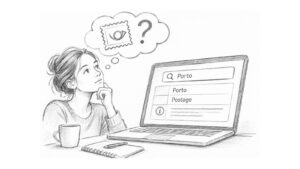
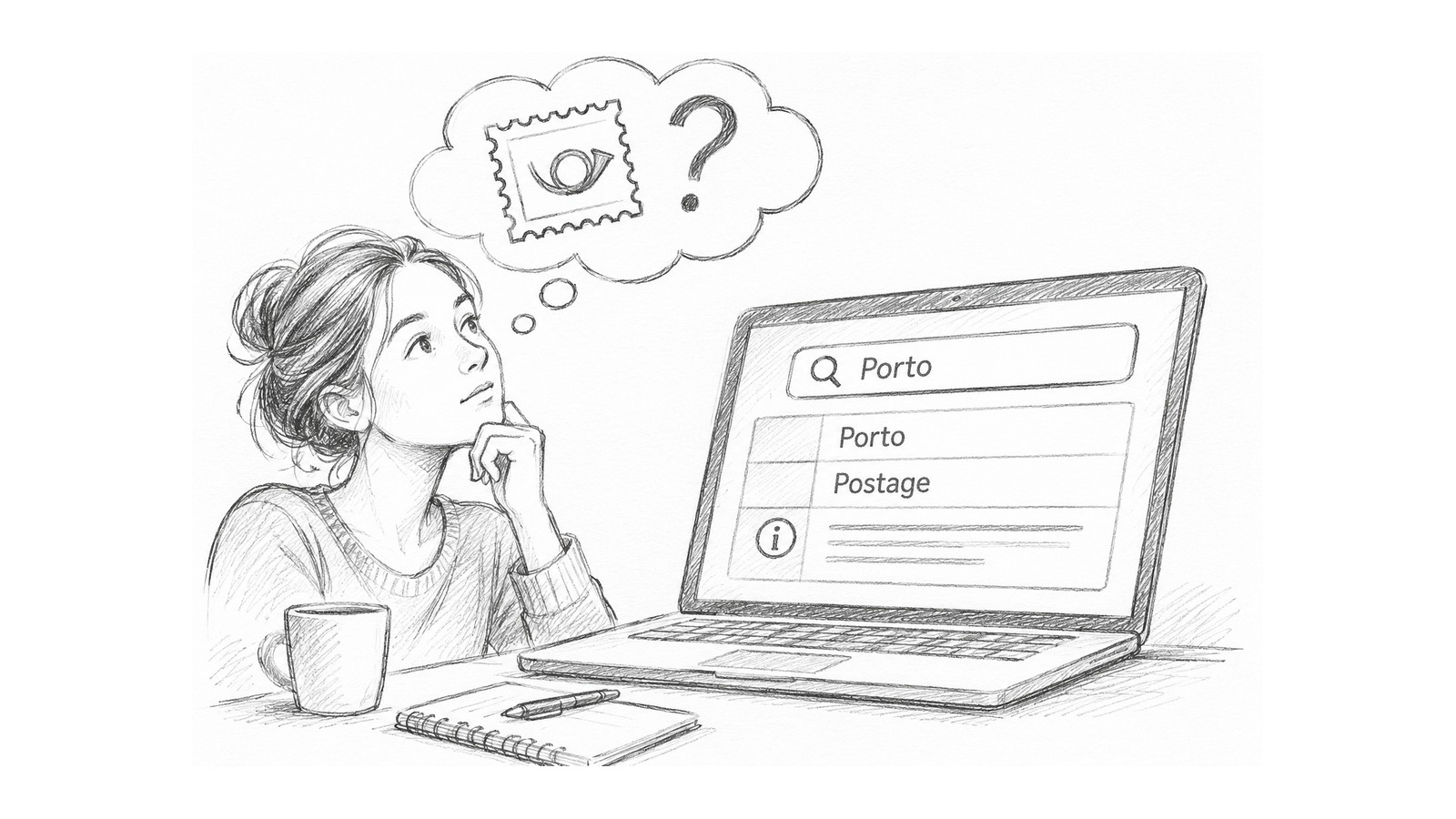
An everyday example: A company buys stamps. They want to record this expense and search the chart of accounts for „stamps“. However, the relevant account is usually called „Porto“. Anyone unfamiliar with this term will not immediately achieve their goal, even if they have a correct understanding of the business transaction.
This is precisely where an important learning question arises: How do I go from a business transaction to the correct German account description – and how can I tell if the account is actually the right one?

The basic principles of double-entry bookkeeping are not confined to Germany. Debits and credits, assets and liabilities, and expenses and income are familiar concepts to experienced professionals in many countries. Nevertheless, a chart of accounts used abroad cannot simply be translated word for word into the German system.
An accounting term may have several colloquial equivalents. Sometimes you come across a general term, sometimes a more specific account. And occasionally, it is only the exact circumstances that determine whether an expense account or a balance sheet account should be used at all.
Incidentally, this doesn’t just apply to people whose mother tongue is English or Russian. Even German-speaking beginners initially look for everyday words and have to learn how the same processes are referred to in accounting.
A Chart of accounts is a systematic framework for accounting accounts. The individual accounts have names and numbers. A company uses the chart of accounts to draw up its own Chart of Accounts: It imports the necessary accounts and allows him to adapt them to his business activities.
The standard charts of accounts most commonly used in Germany include the SKR 03 and the SKR 04 DATEV. Both are used for the systematic recording of business transactions, but differ in their structure:
An account with similar content may therefore have a different number in SKR 03 than in SKR 04. Which account number you use depends on the chart of accounts used and your individual chart of accounts.
We explain the structure of both charts of accounts in more detail in our article „SKR 03 and SKR 04 chart of accounts – what are the differences?“. This is primarily about the practical process of finding a suitable account.
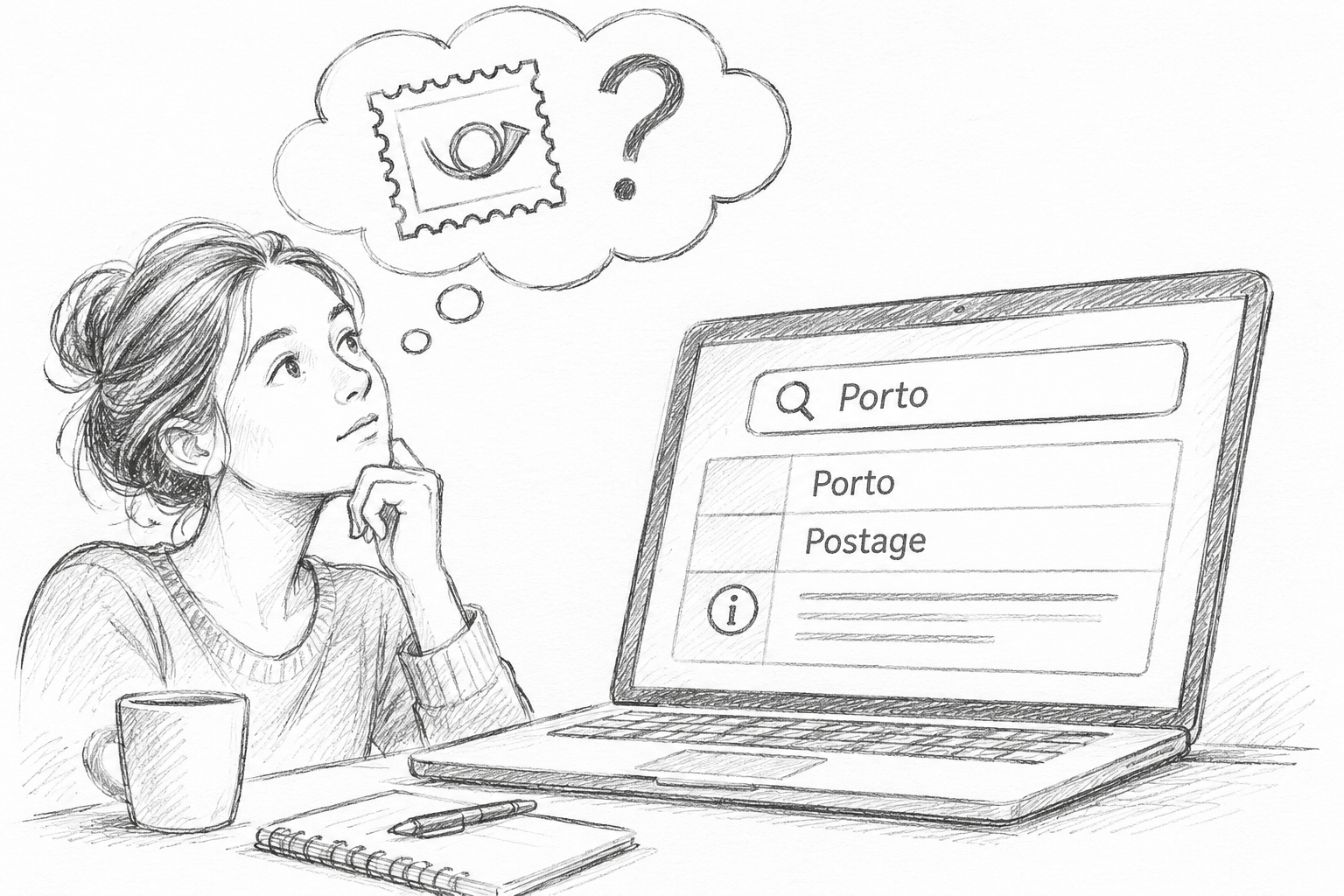
You are buying stamps to post business letters. The account name you are looking for is, in the standard DATEV chart of accounts, „Porto“. If you simply search for „stamps“, you might overlook the account. It helps to know the technical accounting term in this case.
A company receives an invoice for the disposal of commercial waste. A search for „rubbish“ may not necessarily yield the expected account description. Depending on the chart of accounts and the nature of the costs, relevant accounts for disposal costs or other operating expenses may be considered.
It is therefore not just a matter of finding an alternative term. You must also determine, what performance how it was settled and how it is recorded within the company.
In the case of a purchased computer, simply translating „computer“ as „Computer“ is not sufficient. For account allocation purposes, for example, the operational circumstances and the treatment under tax and commercial law must be examined. In some circumstances, an asset may need to be recognised; in other cases, certain simplification rules or direct expensing may be applicable.
The key finding: An account translation helps with identification. The account description helps with understanding. To make a technically correct entry, one must also assess the business transaction.
Anyone who has already learnt bookkeeping will not want to start building up their knowledge from scratch unnecessarily. It is often more helpful to bridge the gap between what they already know and the German chart of accounts.
For our range of learning programmes Accounting Bridge We have therefore developed an interactive tool within the Moodle learning environment to help users navigate the SKR 03 and SKR 04 chart of accounts.
Learners can select the chart of accounts and search by account number or term. English or Russian translations of the German account names are displayed, along with brief explanations of how the accounts are used. Furthermore, the foreign-language names can be hidden for vocabulary practice.
This does more than just produce a list of translations. The tool links the Account number and the German technical term including a language specification and an explanation of what the account is intended for.
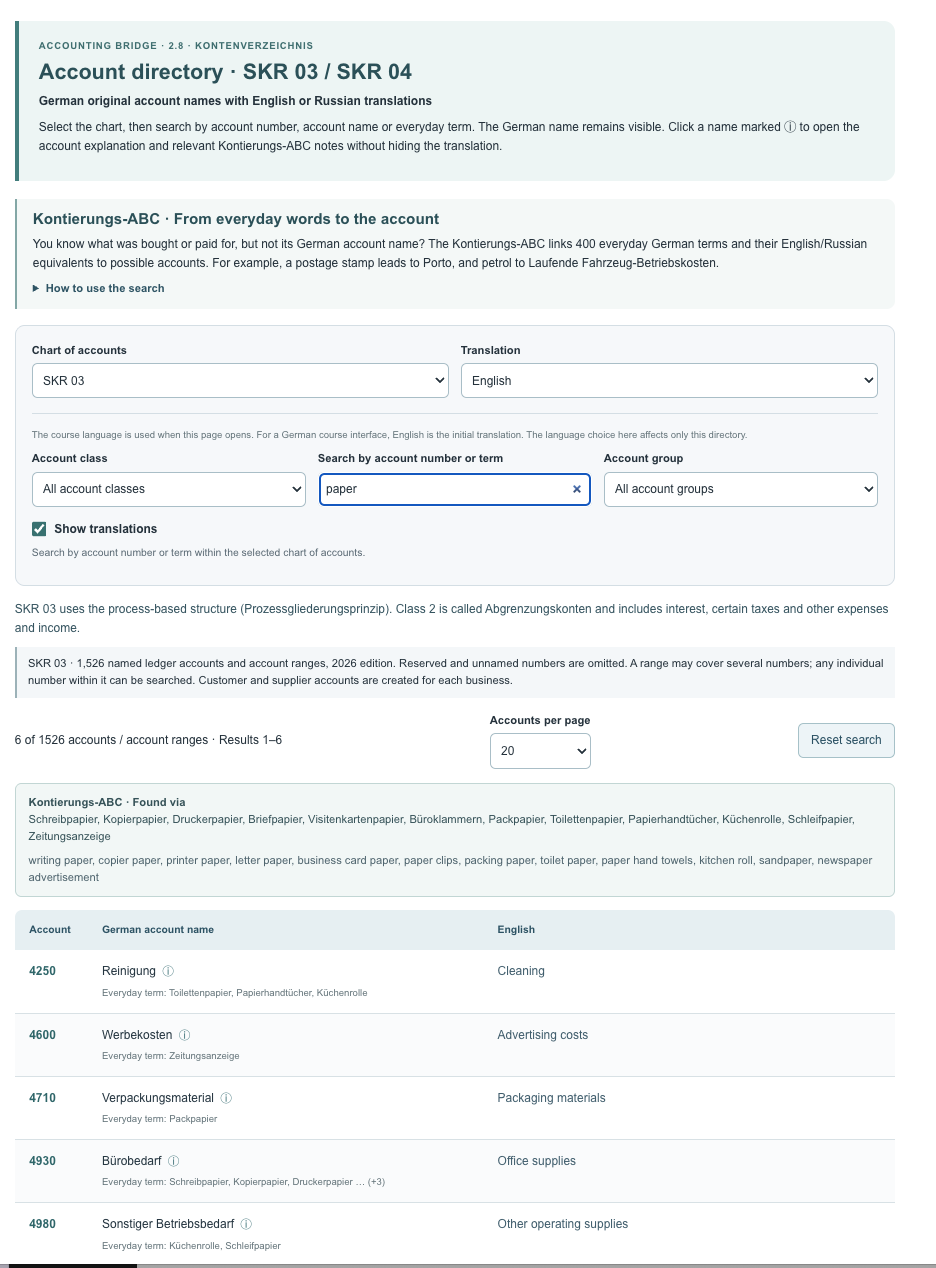
DATEV itself provides English-language overviews of SKR 03 and SKR 04. This is a valuable starting point. Our study guide also has a didactic aim: the accounts should not merely be looked up, but their use should be understood and linked to familiar accounting knowledge.
We are developing the learning aid to be a The ABCs of Account Allocation continue. In future, colloquial and alternative terms are also to be matched with the appropriate accounting terms.
The underlying problem is simple: anyone who enters „stamps“ is thinking of the actual purchase. The accounting account, however, is called „postage“. Similarly, search terms such as „rubbish“ or „waste disposal“ may lead to an account with a different technical designation.
The planned expansion is intended to make such links easier to find. The Accounting ABC is still under development; it should therefore not be equated with an automatic account allocation that is already fully available. The substantive review of a business transaction will remain important in future as well.
It is precisely this approach that is of interest not only to international accounting professionals. Anyone new to German accounting will also benefit from practising the transition from everyday language to precise technical terminology.
Searching for accounts is only one part of the transition to German accounting practices. Other factors include, for example, German regulations, deadlines, the technical terminology used in day-to-day bookkeeping, and how to use the software employed here.
Our further training Accounting Bridge It is therefore aimed in particular at people who already have some knowledge of bookkeeping and wish to build on this to work with the German accounting system. Language support is currently available in German, English and Russian.
This allows those interested to decide, based on their prior knowledge, whether they would like to start by familiarising themselves with German accounting terminology, work with DATEV, or gain comprehensive practical experience in processing business transactions.
Yes. DATEV offers English versions of both standard charts of accounts for free download. In order to post entries correctly, you need not only the translation but also an understanding of how the accounts are used.
This is because the chart of accounts often uses technical accounting terms rather than the words commonly used in everyday language. For example, stamps for business post are usually allocated to the „postage“ category.
No, not without checking. The two charts of accounts have different structures. It is therefore always necessary to take into account which chart of accounts or individual account plan is being used.
A translation makes it easier to get started, but it is no substitute for a professional decision on account allocation. The key factors are the actual business transaction, the function of the account and the relevant German accounting rules.
If you already know how to do the books, you don’t necessarily have to start from scratch. Often, the challenge lies in linking familiar concepts to the German account names, account numbers and rules.
A multilingual account search feature with clear explanations can make this learning process easier. That is precisely why we developed the learning aid in Accounting Bridge – and we are working to expand it further with the ‘Accounting ABC’.
Would you like to apply your existing accounting knowledge to German financial accounting? Find out more about Accounting Bridge and the course options available.